
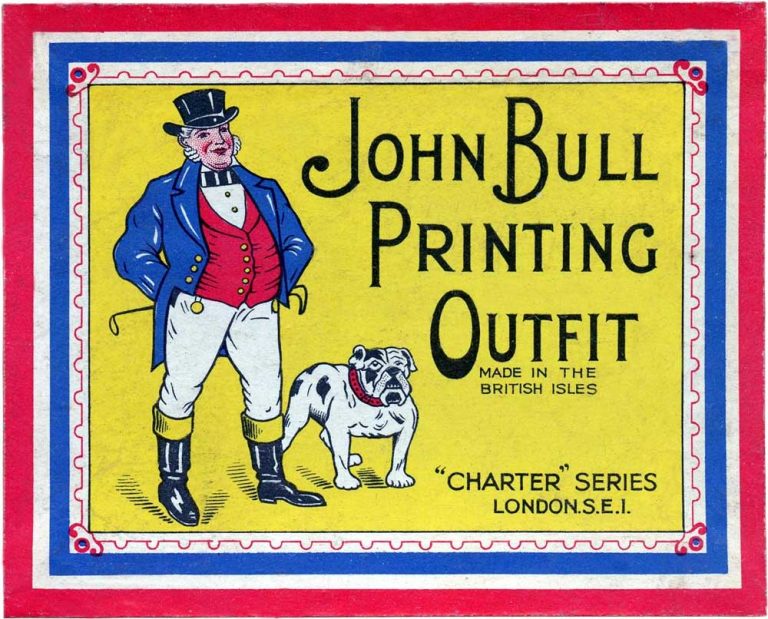

The John Bull printing set has to be included here because it was the initial driver for so many hobby printers to enter the craft. The pages of the BPS’s Small Printer are littered with the accounts of this being the first time some printers used types and ink to leave words on a page.
The concept is simple: individual types, usually made from rubber are assembled on a wooden or plastic channel, with a handle on top. The assembled handle, channel and types is pushed against an ink pad, inked and then impressed on the page.
Before John Bull
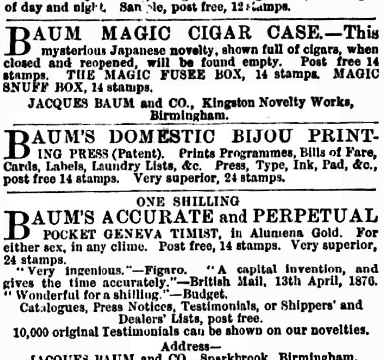
Jacques Baum & Co. of Birmingham advertised a ‘Printing Press’ in the 1870s, which in fact was a forerunner of the John Bull set — a narrow trough of brass in to which metal type was set.
One commentator said: ‘This is a mere toy for printing a single line of type. It is a narrow trough of brass in which the type is fixed.1’
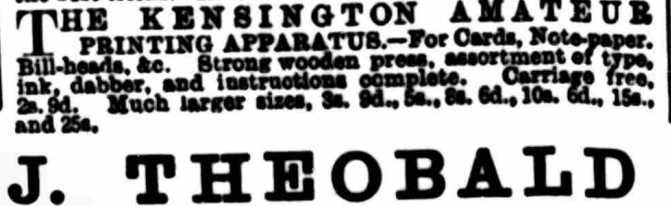
Theobald & Co also advertised their ‘Printing Apparatus’ with the word ‘dabber’ suggesting a similar kit to the John Bull offer.
John Bull Sets
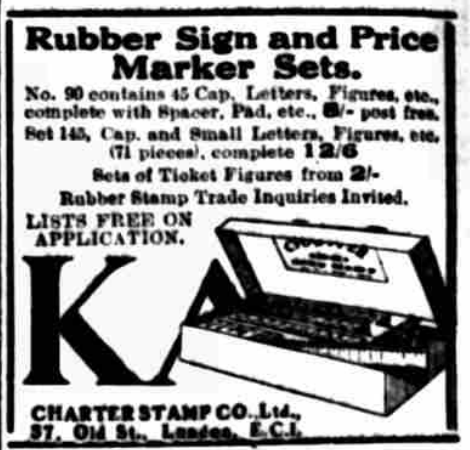
The Charter Stamp company looks to have been established in March 1922, to sell both standard rubber stamps (like in the commercial advert here) and toys. Bob Richardson’s detective work2 gives an earlier possible date of 1916 when a Wandsworth Stationer sold a John Bull Printing Set, indicating that the product might pre-date establishing the company.
The firm applied for their trade mark in 19272 and in 1938 moved to 57 Southwark Street.
Over the period that the firm existed they produced multiple sets, each bearing a reference number that had no connection with the scale or size of the set, or even with earlier sets bearing the same numbers!
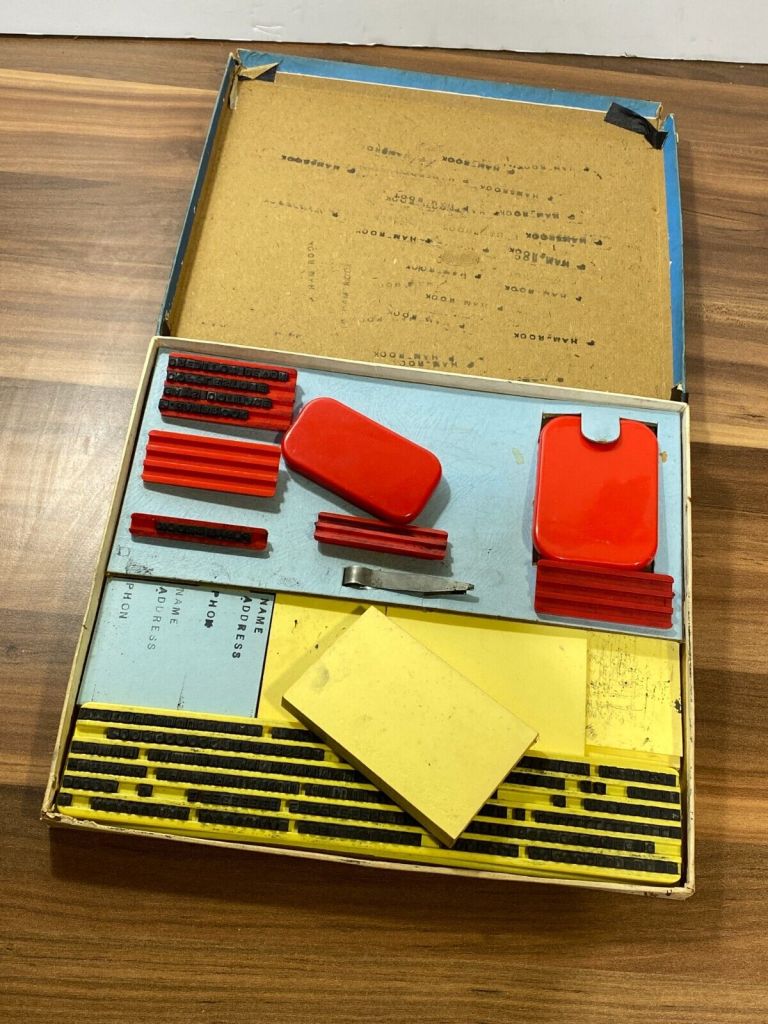

It appears that the firm made most of its own components, including a special formulation of ink, so as not to be harmful for children deciding to drink it, and cutting rubber plates containing letters in to the familiar strips that are partially divided in to letters. This was achieved by taking rubber sheets and using two guillotine cuts — one shallow to split the types on each line, but leave a join at the bottom; and the second to cut fully each line of type from the next.

The firm also experimented with other, similar, products including a different type of patented type holder in 1946, and in the same year, a cardboard holder for individual metal types.
Carson Baker was dissolved in 19882, but a vestige of the product appeared to live on with a supplier that had the components made in China. I called their number this week, but found it disconnected.
Criminal Uses!
A search for John Bull sets in newspapers suggests that they had a minor role to play in criminals’ work. It’s easy today to create a great copy of a document using a PC, but back in the age of the John Bull set, this was perhaps one way to lend a sense of authenticity to a document. In October 1976, the Hammersmith & Shepherds Bush Gazette reported on a Social Security fraud where blank DHSS vouchers had been stolen and then been typewritten over then stamped with a John Bull set to allow criminals to take £28,000 they were not entitled to.
As late as April 1996, a Grantham tyre firm was defrauded as takings were not being paid in to the bank as they should have been. Someone was taking the money home and using a John Bull set to fake the Bank’s rubber stamps on the paying in book.
Today’s Sets
Sets are available today, this ‘Shiny’ kit on Amazon looking closest to the original John Bull sets. A nice development on these is the self-inking kit, and I’m rather fond of this circular DIY self-inking stamp.
Year and Era
1927 / Craft
Object Type
Other Objects
Location
57 Southwark Street, London; as home to the Charter Stamp Company, maker of the John Bull sets.
Sources and More Information
- Moran, James, Printing Presses and Their Development
- Richardson, Robt., Mr Baker’s Rubber Alphabet, in Small Printer, 2008, plus summary on St Bride’s Blog
An Appeal
If you have something linked to this object, please get in touch.
Header Image: “John Bull Printing Outfit” flickr photo by healthserviceglasses https://flickr.com/photos/healthserviceglasses/3755557097 shared under a Creative Commons (BY-SA) license
 British Letterpress in 100 Objects
Wow – thanks for the trip down memory lane!
LikeLike