

Following World War II, the spectre of nuclear attack faced the UK and civil defence organisations were established with a changed focus of the aftermath of such an attack. It seems fair to assume the The Times‘ development of a mobile printing unit was driven in part by the need to maintain continuity of even a small part of their work, just as the BBC and others were developing wartime broadcasting services.
From a printers point of view, the way they approached the challenge, the equipment selected and the way it was tested is fascinating.
It appears that the plan for a mobile works was created in 19511, and was shown off to the public at the British Industries Fair at Olympia in 19532.
“The Times” Is the only daily newspaper in the English language with an unbroken continuity for the past 168 years, and the unit is built to ensure production and publication even if the main printing house should be destroyed, for instance by enemy action.
Derry Journal, 20 November 1953
Transport and Accommodation
The full complement of transport and accommodation was made up of —
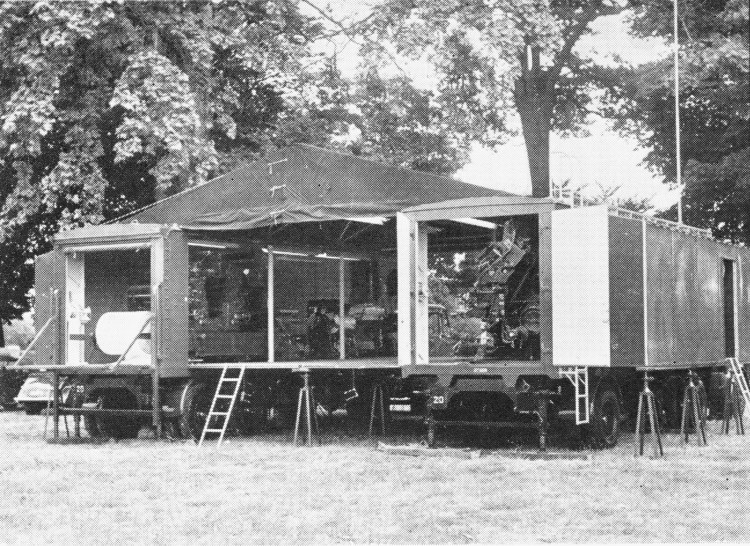
- 2 x Leyland Beaver tractors each hauling a ‘semi-trailer’. This carried the main production parts of the newspaper.
- A Dennis Lorry holding stores of paper and ink, with a trailer containing a diesel engine and generator to power the printing works.
- 4 x Landrovers, for editorial staff, and to distribute the printed paper. Once Landrover was equipped with radio equipment to link with the printing works.
The whole operation could be assembled by a crew of six to be ready in two hours.
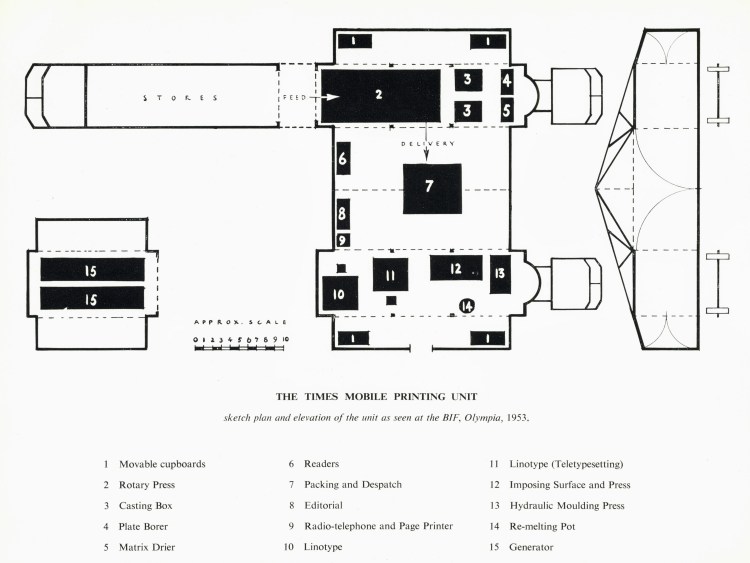
The process of getting ready was to align the two trailers, flip down the size walls so they connected with each other (providing an open space between the two trailers held on jacks), and opening the other side of each trailer. The main void between the two trailers was covered with an aluminium frame, heavy canvas covering and strip lighting installed. In terms of being ‘battle-ready’, the British Printer noted that ‘…construction is such that an efficient ‘black-out’ is obtained.’
Printing Equipment
The main press was a Timpson Rotary press, specially designed and built by them with an output at maximum speed of 12,500 copies per hour. Typesetting was through two Linotype machines (although the Reading Standard suggested Monotype machines were used). One Linotype was equipped with teletypesetting equipment to be used in conjunction with the radio equipment on one of the Landrovers.
Of course, to get from the Linotype slugs to the rotary press required that a flong be created which was then used to cast a 5/16th of an inch curved metal plate for use on the rotary press.
The Emergency Newspaper and Typography
The edition of The Times was to be a 16″ × 10″ newspaper of eight pages, each being four 13em columns wide separated by brass column rules. The Linotype machines included 7pt and 9pt Times Roman and the associated Italic. Headlines were set in 10pt or 12pt Times Heavy Titling. Since so much extra equipment would be needed to reproduce photos, no provision was made for halftones or other illustrations.
Testing or Exercising
The set-up produced newspapers as souvenirs of the British Industries Fair in 1953, but more curious is the local newspaper report from Reading in 1955.
The Reading Standard reported that in the tiny village of Sulhamstead the whole column of vehicles made their way to a farmyard to set up overnight during a newspaper strike. At the weekend, ‘boys from Pangbourne Nautical College and Bradfield College’ were invited to see the Mobile Printing Works in action and they too were presented with newspapers as souvenirs of their visit.
Final Reflections
The Times took seriously its role as a newspaper of record for the UK, and London’s susceptibility to the Blitz and the possibility of nuclear war meant the paper had to look at ways to ensure continuity of production.
While I’ve listed the location as Printing House Square, the then-home of The Times, it would have been foolish to keep this reserve printing plant in such a vulnerable location. It’s intriguing as to where this works was kept and how long for. By 1968 the Industrial Civil Defence Society had been disbanded and the BBC was well under way with preparations to inform in the case of war. Especially odd is the absence of a national reference to the testing of the plant in a farmyard in Berkshire in 1955.
References
- A Newspaper on Wheels — Times Mobile Printing Unit in Berks Farmyard (20 May 1955), The Reading Standard.
- A Newspaper Office on Wheels — The Times Mobile Printing Unit (July 1953), Print In Britain.
Year and Era
1951 / Modern
Object Type
Other Objects
Location
Printing House Square, London
Sources and More Information
- The Times Mobile Printing Unit, Print In Britain, June 1953
An Appeal
If you have something linked to this object, please get in touch.
Header Image: The Derry Journal, 30 November 1953
 British Letterpress in 100 Objects