
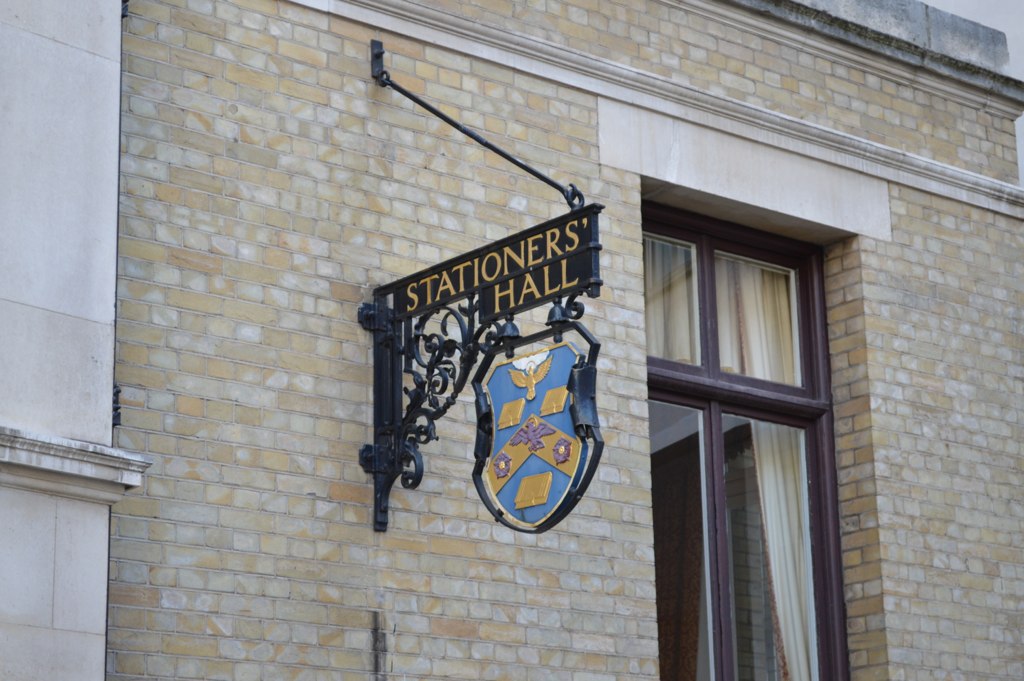
In common with other European countries, Guilds were formed where men had common economic interests and objectives and these had different degrees of control on their trades until the end of the 18th century, or beginning of the industrial revolution.
In London, the Mayor and Chamberlain leased stations for trading purposes around St. Paul’s and the name ‘stationer’ might come from the stations these traders occupied, but there is no definitive origin of the term ‘stationer’1.
Early Days
By the fourteenth century there were writers of courthand and text and illuminators, each exempt from jury service. By 1373 there was a distinct guild of Writers of Court Letter.
The stationers applied for a charter (to the Crown) in 1542 and for permission to form a guild, or a Livery Company to the City of London. The colours awarded were scarlet and brown-blue. The Charter was granted on 4 May 1557 and the group became the Company of Stationers.
Monopoly
The emerging power of the printing press was keenly limited, including Henry VIII’s order that his Privy Council should examine each book. Through the Stationers’ Charter of 1557, it was forbidden for any person to practice the art or mystery of printing unless he was a member of the Company; or held a Royal Letters Patent.
John Day was the first person to be admitted to the livery of the Company and was Warden in 1564 and three later years before being Master of the Company in 1580.
This 1557 Charter, by the way, was destroyed by the Great Fire of London.
to search take and carry away all presses, letters and other pryntinge instrumentes sett up, used or employed . . contrary to the intent and meaninge hereof; . . . and thereupon shall cause all suche printing presses, or other printing instruments, to be Defaced, melted, sawed in peeces, broken, or battered
Star Chamber decree of 1586, allowing the Stationers’ Company to inspect all printing offices. My rubrication.
Stationers’ Company Register
The Charter for the Company also enforced that no other person had a ‘right to copy’ a book once a member of the Company had shown that they owned the text.
The usual way of showing ownership of a text was for a entry to be made in the Company’s Register, which was established in 1595. This status — showing proof of publisher’s ownership (not author!) — was included in the 1684 re-creation of the original Charter.
An 1871 account of the Company explains there were two entrances to the Hall — one for Members which is ‘very stately’, and another ‘humble’ entrance for those attending to pay tolls and tax.
End of the Monopoly
By 1695 the monopoly over the mystery of printing had ended. And the need to register books with the Company to evidence ownership ended in December 1923.
As the demand for more and more printed materials grew, a wider range of boys entered the craft, diluting what had been an almost ‘hereditary caste of men’2. The number of UK printers doubled between 1831 and 1851. Over time the unions took more of a role of limiting entry to the profession.
Organising the Company and Education
The Company is governed by a Master, two Wardens, and a Court of Assistants. These were originally designed to enforce craft discipline documented in the Orders, Rules and Ordinances of the Company.
A School — The Stationers’ Company’s School — was opened in Fleet Street in 1861 but additional space was needed and this moved to Hornsey in 1894, closing in 1983. In 2014, the Stationers’ began to support the Stationers’ Crown Woods Academy in Eltham.
Stationers’ Hall
The Guild was originally based at Peter’s College before buying Abergavenny House in 1606. This was destroyed in the Great Fire of 1666, but re-built by 1673.
Role Today
The Company’s original role has moved on, and the Company today seeks to provide a forum for those in the communications and content industries, with charitable activities focussed on education, training heritage and welfare.
Year and Era
1557 (Date of Royal Charter) / Craft
Object Type
Firms and Organisations
Location
Stationers’ Hall, London
References
- Hutchings, R. S., Editor, The British Printer, April 1957
- Skingsley, T. A., Journal of the Printing Historical Society — Technical Training and Education, No. 13
An Appeal
If you have something linked to this object, please get in touch.
Header Image: “Stationers Hall” flickr photo by Matt From London https://flickr.com/photos/londonmatt/16589657873 shared under a Creative Commons (BY) license
 British Letterpress in 100 Objects
1 comment