
The rule bending machine is a mere tool to achieve what the wider jobbing letterpress world was aiming for at the end of the 1800s.
It was easy, looking back from the 1920s, to scoff at the complexity and madness of the 1880s and 1890s, but the there’s some inevitability to how printers ended up working in this way.
The Artistic Printing movement capitalised on Victorian love of ornament, the new equipment and new capabilities of printing, and the expanding markets opening up ordinary printing to more people.
At first glance the style has no obvious rules, one commentator saying ‘The characteristics of artistic printing can be simply summarized: an absence of any rules or obvious logic the disposition of visual elements…’1. In his article for the Journal of the Printing Historical Society, Graham Hudson remarks that this is probably linked to the fact that artistic printing was a phenomenon in the world of jobbing printing, but hardly impacted book work; and that there were in fact lots of subtle rules that make up the style2.
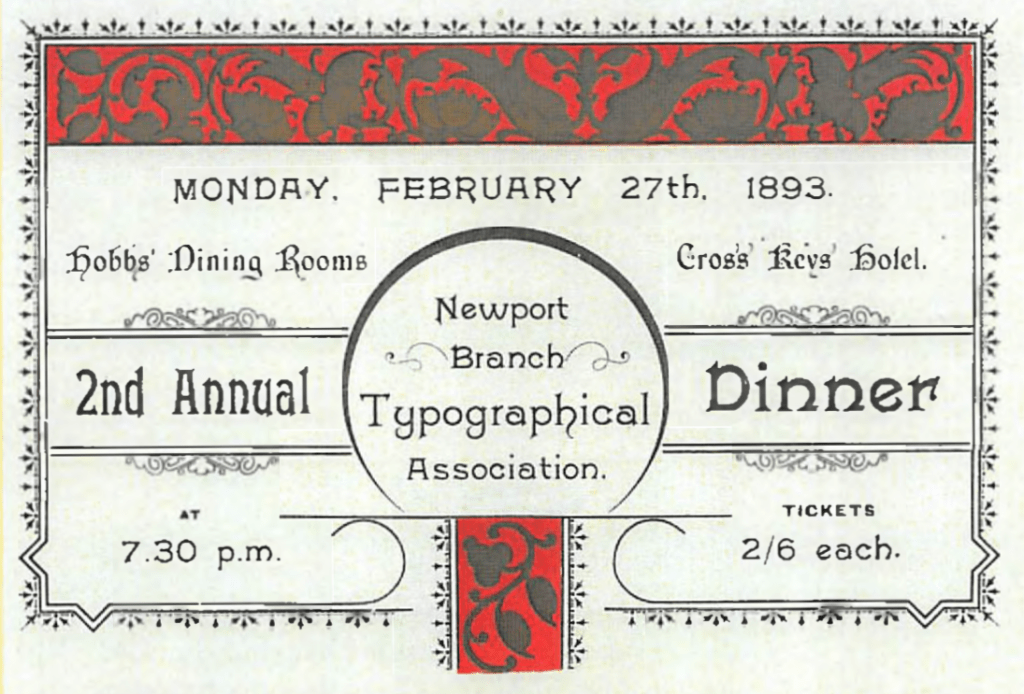
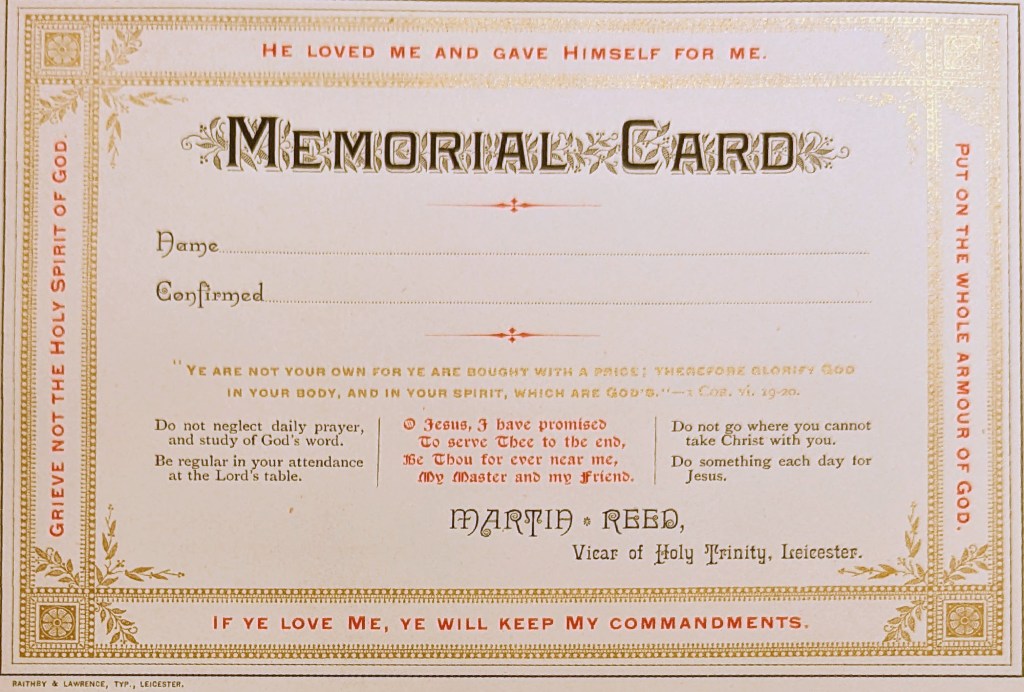
Where earlier jobbing would would have been black, centred and a small number of types, artistic printing included banners, ribbons, 3D shading, curved rules and lines of highly decorated types. As well as this variety of printing material, many colours were used.
The end results, even from local jobbing offices would be as below.
Sharing Ideas
While critics were not pleased with the gaudy-ness of artistic printing, the public enjoyed this daring relief from the printing they had become used to.
Harold Hood in The British Printer, September 1920
…these qualities of sensation, of daring and crude and unconventional design, of acrobatic performances in the way of rule-twisting, and myriad tints and gilt printings—awoke enthusiasms in many a young man of that day.
A key driver in adopting the style was Harpel’s Typograph or book of specimens, by Oscar Harpel of Cincinnati. This 1870 book acted as the best practice manual for artistic printers and was acknowledged in the 1890s as having done most to advance the craft of the artistic printer.

The follow-on from this US-produced manual was the more collaborative Printers’ International Specimen Exchange, led by London printers Field & Tuer who responded to a Cheltenham printer’s request to share specimens.

The full books are available online through Hathi Trust and show off the wide appeal of the style, and the varying approaches to artistic printing.
Tuer’s editor, Robert Hilton, acquired the rights to the Exchange on dismissal in 1887 and was later instrumental in the launch of the British Printer magazine.
Artistic Printing Luminaries
Some names come up more than once when going over artistic printing papers, and just as Bert E. Smith created a new style of using borders at the Curwen Press in the 20th Century, some names to look for are —
- Mr George. W. Jones: regarded by Harold Hood as ‘…the greatest typographic artist in this country [Britain].’
- C. H Fairbanks and Mortimer Read, Harpel’s designer-compositors.
- William Kelly, credited as America’s leading artistic printer, with M. O. McCoy representing the US at the Paris exhibition of 1878.
- Thomas Hailing, the Cheltenham printer suggesting the specimen exchange, and Robert Hilton, an artistic printing advocate who facilitated the exchange.
- Robert Grayson, who lectured on artistic printing to the Leicester Typographical Technical class.
My favourite contemporary rule-bender is Naomi Kent, as inksquasher.
Skills and Equipment
With the advent of artistic printing, compositors needed to be expert in the art, including new skills like rule-bending, assembling many different materials in the same forme, and the art of ‘breaking’ formes for colour — that is splitting the one page in to multiple formes, one for each colour to be printed.
As well as the new types more ornamental material was needed. Some of these — like stock illustrations and border units — could simply be bought from founder, but to make a really unique layout the printer needed to be able to bend their own rules. Rule bending machines would at one time have been near-universal in jobbing offices — surprisingly very few remain.
Starshaped Press offer a wonderful look at the tools of this trade. It doesn’t make lockup any easier when it has to accommodate different materials at different angles and spreading across the page!
Rule-Curving or Rule Bending Machine
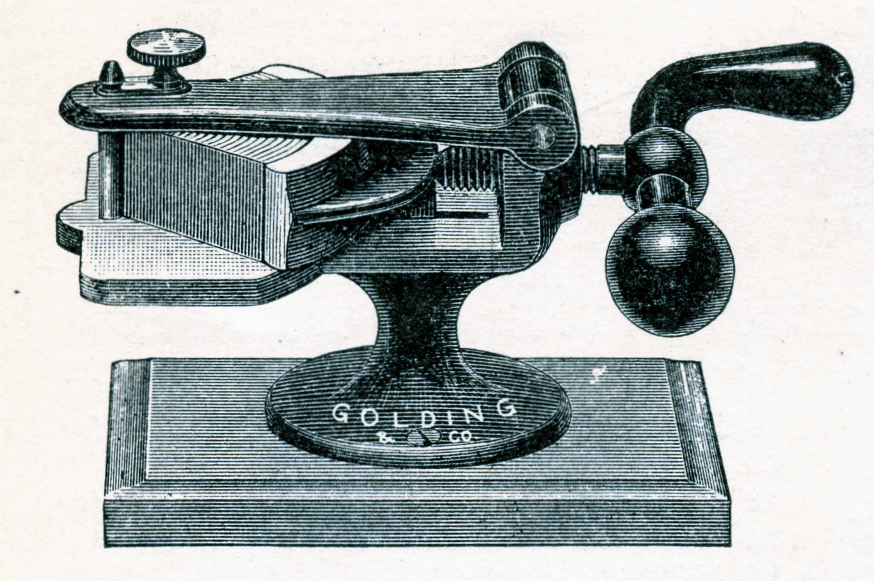
The curving machine acts as a vice in which to bend rule. The top is flipped open, and rule inserted in to one of the channels on the left, these ranging from ¼″ to 8″ in diameter. As the vice closes using the handle on the right the rule is bent to the curve needed.
Printers’ Rule Curver
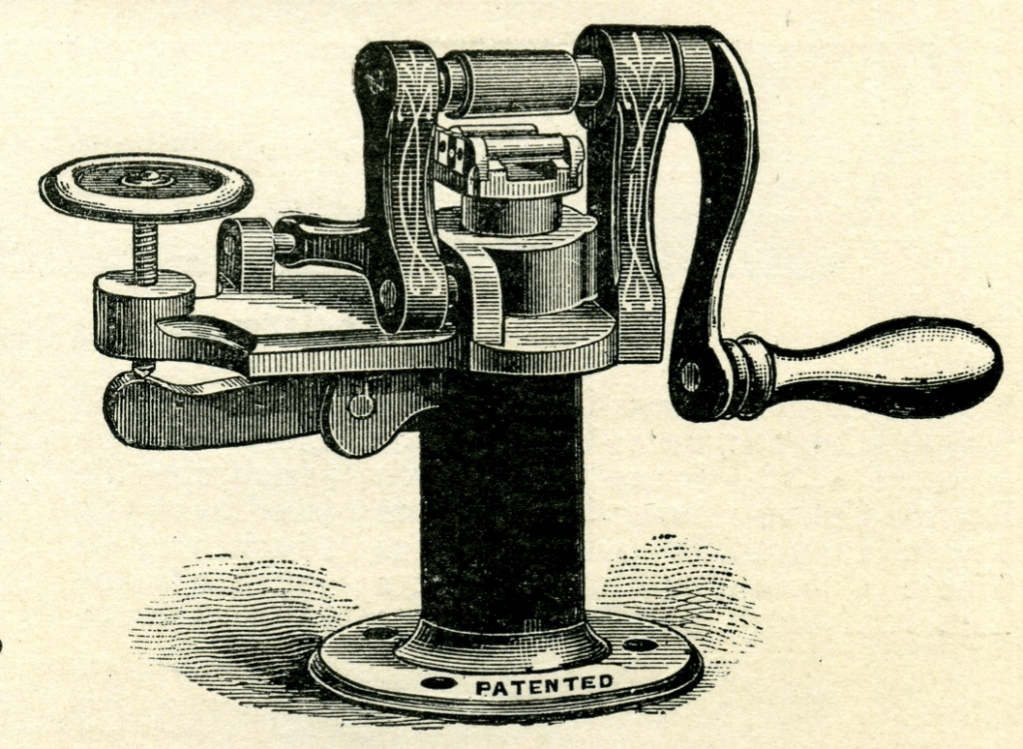
Slightly more expensive and more finely-tuned was the printers’ rule curver. The threaded screw on the left adjusts the lower pair of rollers on the right up or down. Rule is fed between upper and lower rollers and the handle on the right used to feed rule through. The different height of the smaller two rollers causes the rule to be bent as it leaves the machine. An advantage here is that by adjusting the screw while in progress it’s possible to create a spiral of rule.
In 1962 the firm Notting launched a wholly re-designed rule bender handling steel rule up to 8pt. My assumption this was better used for creating cutting formes with cutting rule rather than for artistic printing, being just sixty years late for the craze.
The Wrinkler
A thread from St Bride, including ‘The Wrinkler’.
References
- Kinross, Robin, Modern Typography: an essay in critical history, 1992
- Hudson, Graham, Artistic Printing: a re-evaluation in the Journal of the Printing Historical Society, 2006 or New Series No. 9
Year and Era
1880s-1890s / Mass Production
Object Type
Other Objects
Location
Address used is Raithby, Lawrence & Co’s De Montford Press, as a key proponent of artistic printing. Another option would have been Field & Tuer, as facilitators of the first Printers’ International Specimen Exchange, assuming too that they had rule benders in their own works.
Sources and More Information
- Prosser, Ron, Artistic Printing in Newport, 2012
- Hudson, Graham, Artistic Printing: a re-evaluation in the Journal of the Printing Historical Society, 2006 or New Series No. 9
- Meant-to-be-bent Rules
An Appeal
If you have something linked to this object, please get in touch.
Header image: from the ATF catalog, 1897 hosted by archive.org
 British Letterpress in 100 Objects