
The paper-based business processes of early 20th century commerce required massive amounts of printed articles. It wasn’t always possible to get these professionally printed and just as the Gestetner and Roneo duplicators had allowed typewritten material to be duplicated in an office, there was a gap for something between Gestetner and professionally printed items.
In to this space steps the Multigraph, an American early 1900s invention. The first reference I can see in the UK is a 1913 report of a December 1912 advertising convention where Gammeter-Multigraph was an exhibitor.
Composing was made easier as type was slid on to grooves in the cylinder rather than composed in chases needing locking-up. Makeready was eliminated as a large harder rubber cylinder was under the paper meaning any un-eveness in printing surface was accommodated.
This was great news for the office needing new forms, but less good news for printers that would have had been paid for that work as professionals.
Principles
Press
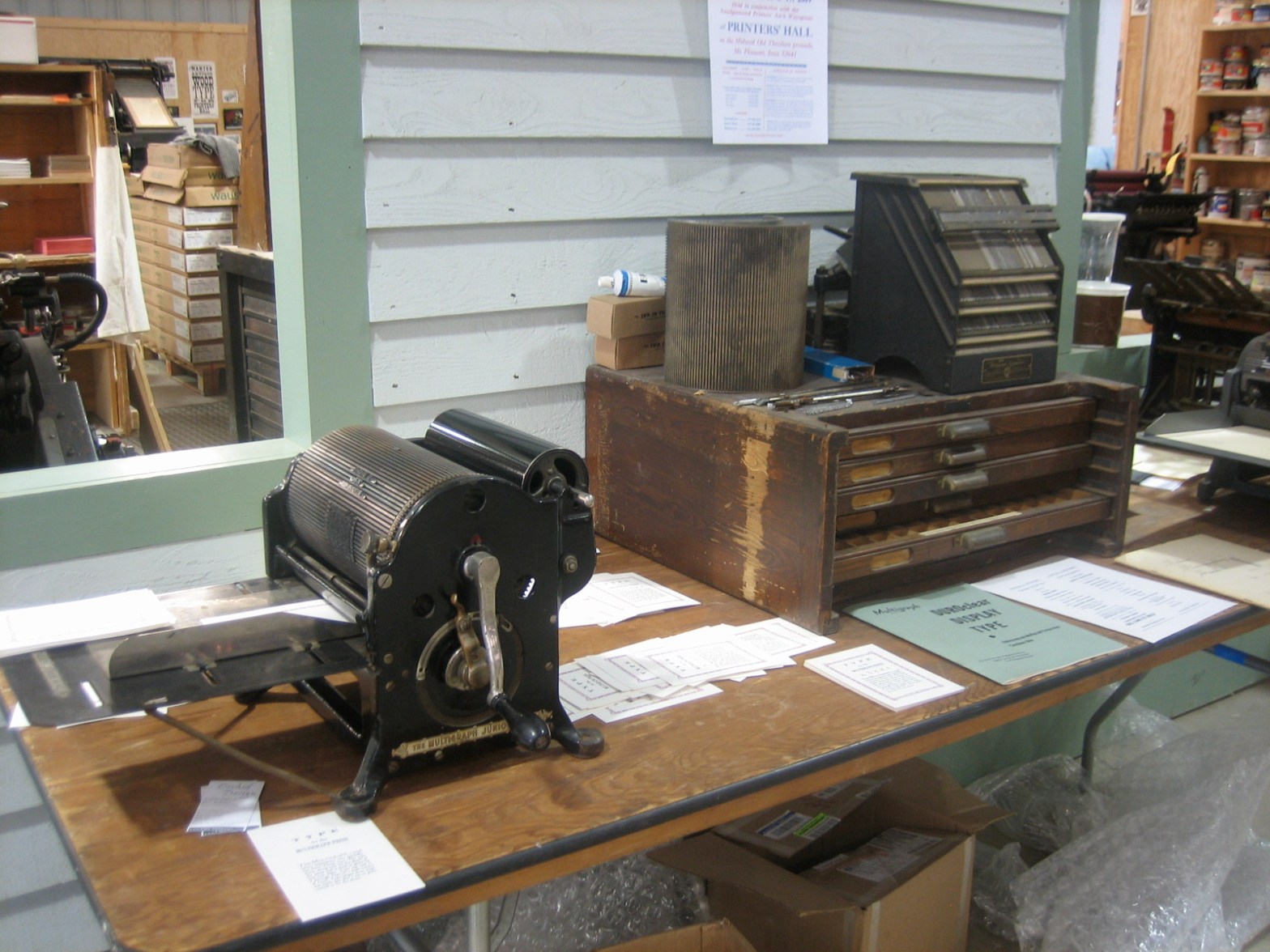
The press looks like a Gestetner/stencil duplicator. A pile of fresh paper one side, a large cylinder to hold the type, an inking method — this could be either printers’ ink transferred through a roller, or a large ribbon like a typewriter. Finally there’s a tray to hold the finished copies that have been through the machine.

These machines were powered from the start with a suggested speed of up to 6,000iph, with the first machines being hand-fed with paper but later machines having a mechanical or suction feed. The later machines offered up to 7,000iph. Printing area is limited to around 8″ × 13″.
Type

Multigraph supplied different styles of type for the machine. The fact that the grooves on the cylinder are around 12pt apart means that each printed line is 12pt or a multiple of 12pt apart. For type larger than 24pt, these were made curved and had multiple ‘feet’ to slide in to the machine’s grooves. The diagram below from the British Printing Society’s Small Printer magazine from 1986 shows the structure of the type.
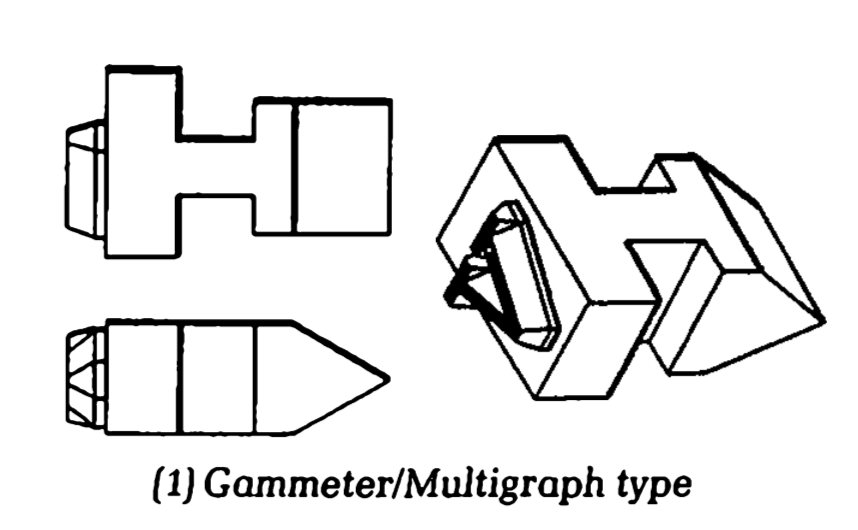
The same article by J. F. Coakley reports that Mouldtype of Preston had 10pt and 12pt moulds for casting faces on to Multigraph bodies, and also one 18pt mould.
Clips hold the type in the channel while in use, and correcting a line means sliding out the whole line from the groove, correcting and replacing. Crucially no other part of the forme needs to be touched.
In addition to the special types, a kind of typograph was created, where type was stored in grooved channels, released by buttons allowing users to type to release a single letter that could be added to the drum.

Uses
While designed to fill that gap between a single typewritten page and professionally-printed matter, the Multigraph was put to use across a variety of printed items.
This old article, through archive.org by Allen Altvater gives a nice account of the many uses his Multigraph was put to including direct mailings for movies, church newsletters, and a study on fires.
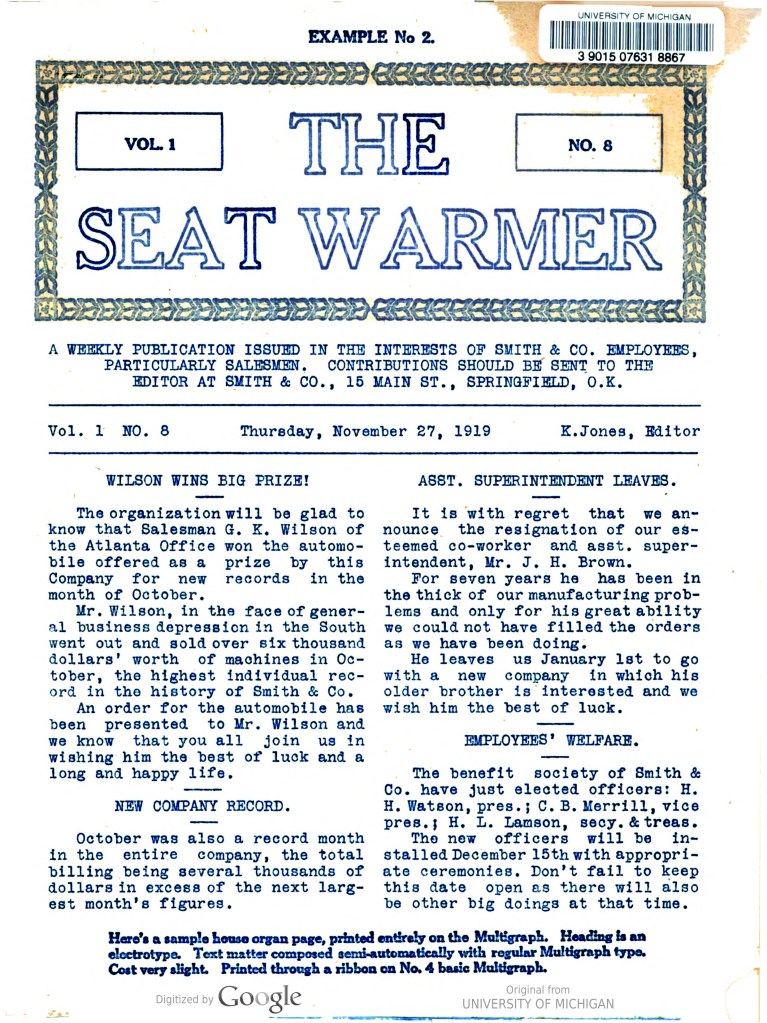
The Multigraph Users’ Service Bulletins provided examples of the type of work the machine and types could do, including this example newsletter, below.
Industry Response
Printers naturally sought to challenge the status of the machine that was drawing off some of their work. In 1925 a question of the Home Department in the House of Commons clarified that a space used for duplicating (or Multigraphing) should be considered in the same way as a letterpress printing works under the Factories Act.
…the increase in the number of multigraph and kindred machines is gradually taking away from the ordinary printer no small proportion of the small jobs many of them used to rely upon.
British Printer, January-February 1926
In 1929, the Master Printers’ Association of New South Wales supported the New South Wales Printing Industry Union in an action to force those doing this type of duplicating to be brought under the same conditions as those that governed the printing trade.
In his 02 October judgement, the Deputy Industrial Commissioner ruled that “that there can be nothing in common between these highly skilled tradesmen, who are solely employed as printers, and the operators of the Roneo and Multigraph machines, who are, comparatively speaking, unskilled junior workers, so far as the operation of the machines is concerned, though, no doubt, they are skilled in their clerical duties, which, on the evidence, constitute the major portion of their work.” The application was dismissed.
Addressograph-Multigraph
The snappily-named Addressograph-Multigraph made more than just the Multigraph machine in the UK. In the early 1950s they marketed offset litho machines especially to smaller printers, including those at home or in-plant works. Their most famous machine is probably the Multilith 1250. The firm was re-named AM Multigraphics some time before 1984.
Roneotype
It looks like Roneo — more famous for their spirit duplicators and metal office furniture — created a machine very similar to the Multgraph called the Roneotype.
European Update
Thomas Gravemaker, a printing friend from the Netherlands reports that label printing — including the labels for VW seatbelts — still use this type of machine in Europe. Type was being cast by Rainer Gerstenberg in Darmstadt up to 72pt until last year. The German name for these types being Kurztypen or ‘short types’.

Year and Era
c. 1910 / Commercial
Object Type
Press
Location
Addressograph-Multigraph Limited, Marylands Avenue, Hemel Hempstead, Hertfordshire
Sources and More Information
- British Printing Society London Newsletter – August 1982
- Dave Robison’s posts on Briar Press
An Appeal
If you have something linked to this object, or can supply more information please get in touch.
Header Image: “Multigraph” flickr photo by firexbrat https://flickr.com/photos/firebrat/3942205130 shared under a Creative Commons (BY-NC-ND) license
 British Letterpress in 100 Objects