
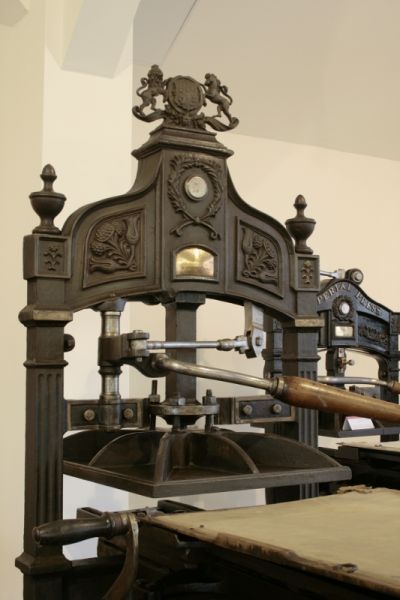
After the earliest, all-wooden presses, the next development was to exploit the better understanding of metal to enhance the printing process. A metal staple had been used in Basle, but it was Earl Stanhope that created the first all-iron press around 1800. By 1813, the Columbian press had been invented by George Clymer of Pennsylvania and other iron hand presses followed1.
To bring us back to the UK, and the less-well-known, this article looks at Leeds’ contribution to the early iron hand presses with the Britannia press. These are relatively small in number, with only a handful known to remain.
Benjamin Porter

Benjamin Porter was born on 13 April 1791 in Leeds, married in 1813 and by 1841 was living in Queen’s Square, Leeds, which, by the way, is still standing and remains gas lit despite the worst of Leeds’ 1970s excesses with the Merrion Centre and the Urban Motorway.
Porter is listed in Leeds newspapers as a ‘whitesmith’, a partner to a blacksmith but working with white metals. We might assume that this was akin to a tinsmith.
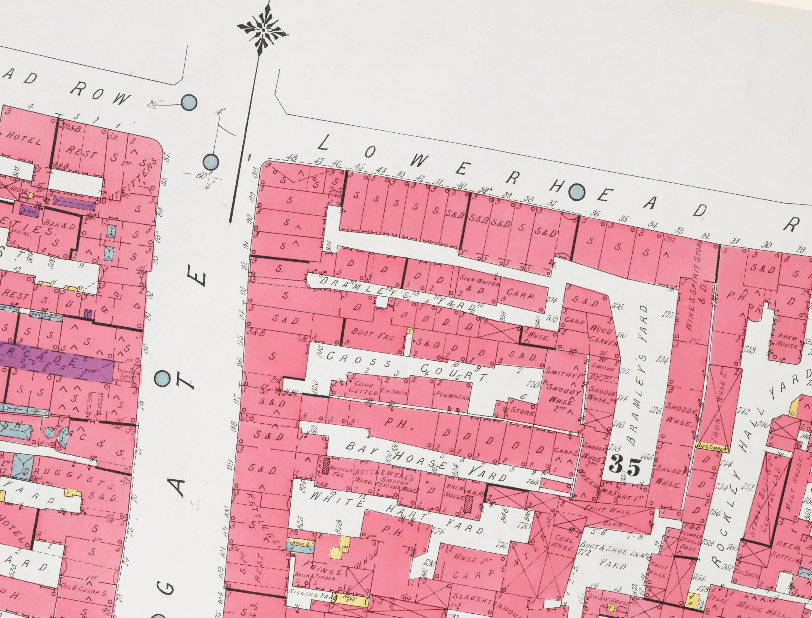
Porter’s works were in a courtyard — Cross Court — off Briggate in Leeds. The 1885 plan below shows Cross Court, but by the time of the plan, Porter’s works had disappeared.
The Britannia Press
While there is no commonly accepted date for the Britannia Press, the earliest reference I can find is March 1832 when Porter announces an un-named press of his invention as new.
TO PRINTERS. — B. PORTER, Whitesmith, Leeds, in calling the Attention of the Profession to his New and Improved PRINTING PRESS.
Leeds Intelligencer, 15 March 1832

The press has a name by 1838 with a headline to Porter’s Britannia Press, calling out the continued improvements and ease of use of the press.
The press is described by Reynolds Stone2 as “…seems to be based on both the Imperial and the Columbian, its action and main form being very similar to the Imperial but the return of the platen being achieved by a counterweight and the pressure adjustment by a threaded lever.”
Moran describes the appearance as being decorated on the front only, with clawed feet and splayed legs.
Whatever may be the respective Merits of the Predecessor [earlier paragraph], Benjamin Porter, the Inventor of the Britannia Press, leaves the Profession to draw their on conclusions, but at the same time respectfully submits that the perfect combination of the desirable qualities of Ease, Expedition and Durability have been reserved for his Invention.”
Leeds Times, 20 August 1842

Porter’s adverts each invite people to seek testimonials from the local area of printers that are keen to tell others of the delight of the Britannia. The list of users suggests that the press stayed ‘close to home’. Moran said1 ‘In his Printer’s Manual of 1838, C. Timperley reports that the Britannia press was highly spoken of by many practical printers and extensively patronized in the counties of York and Lancaster’.
The Britannia Press is now in Operation at the Leeds Intelligencer Office, Leeds Mercury Office, Leeds Times Office, Sheffield Iris Office, Sheffield Independent Office, Wakefield Journal Office, Liverpool Times Office, and in the Offices of numerous Letter-Press Printers in Yorkshire, Lincolnshire and the neighbouring Counties.
Leeds Intelligencer, 12 May 1838.
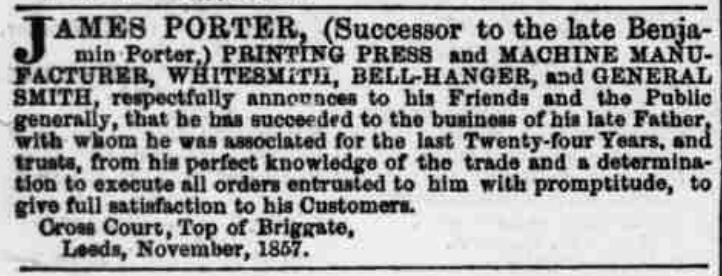
It appears that Benjamin died in 1851 but there then is a significant delay between this and his son announcing that the business would carry on under his name. Curiously, it looks like the printing machines were the smaller part of the business also listing bell-hanging, whitesmithing and ‘general smithing’.
Miniature Britannia Presses
While the presses themselves are rare, even rarer still must be the miniature Britannia Presses that Porter presented to different organisations locally.
The Leeds Intelligencer for 06 June 1840 reports that the Halifax Mechanics’ Institution held an exhibition for which Porter supplied a miniature Britannia press described as ‘…very beautiful specimen of workmanship”, weighing 28lbs and being 10″ × 14″ capable of printing a card of 3¼″ × 4¼″.
Britannia Presses Today
In March 1978 the Printing Historical Society reported to know of eight Britannia presses in the North of England.
Jeremy Winkworth provided a fuller list of known Britannia Presses in the BPS’s Small Printer magazine in 2008. The key, public owned or publicly available Britannia presses are —
- Leeds Industrial Museum, at least two presses
- Science Museum, London
- John Rylands Library, Manchester
- Museum of Science and Industry, Manchester
- Wordsworth Trust, Grasmere
- Craven Museum, Skipton
- Dundee Contemporary Arts, as below
- Leicester Print Workshop
- Scarborough Technical College
- In a private collection is Michael Atkin’s Britannia Press at Bracken Press.
References
- Moran, James, Printing Presses History and Development from the 15th Century to Modern Times.
- Reynolds Stone, (1967). Printing Historical Society Journal No. 3
Year and Era
1832 / Craft
Object Type
Press
Location
96 Briggate, Leeds
Sources and More Information
- Winkworth, Jeremy, (2009) Small Printer
- Final two presses added from Michael Atkin
An Appeal
If you have something linked to this object, know of a Britannia press or can supply more information please get in touch.
 British Letterpress in 100 Objects