
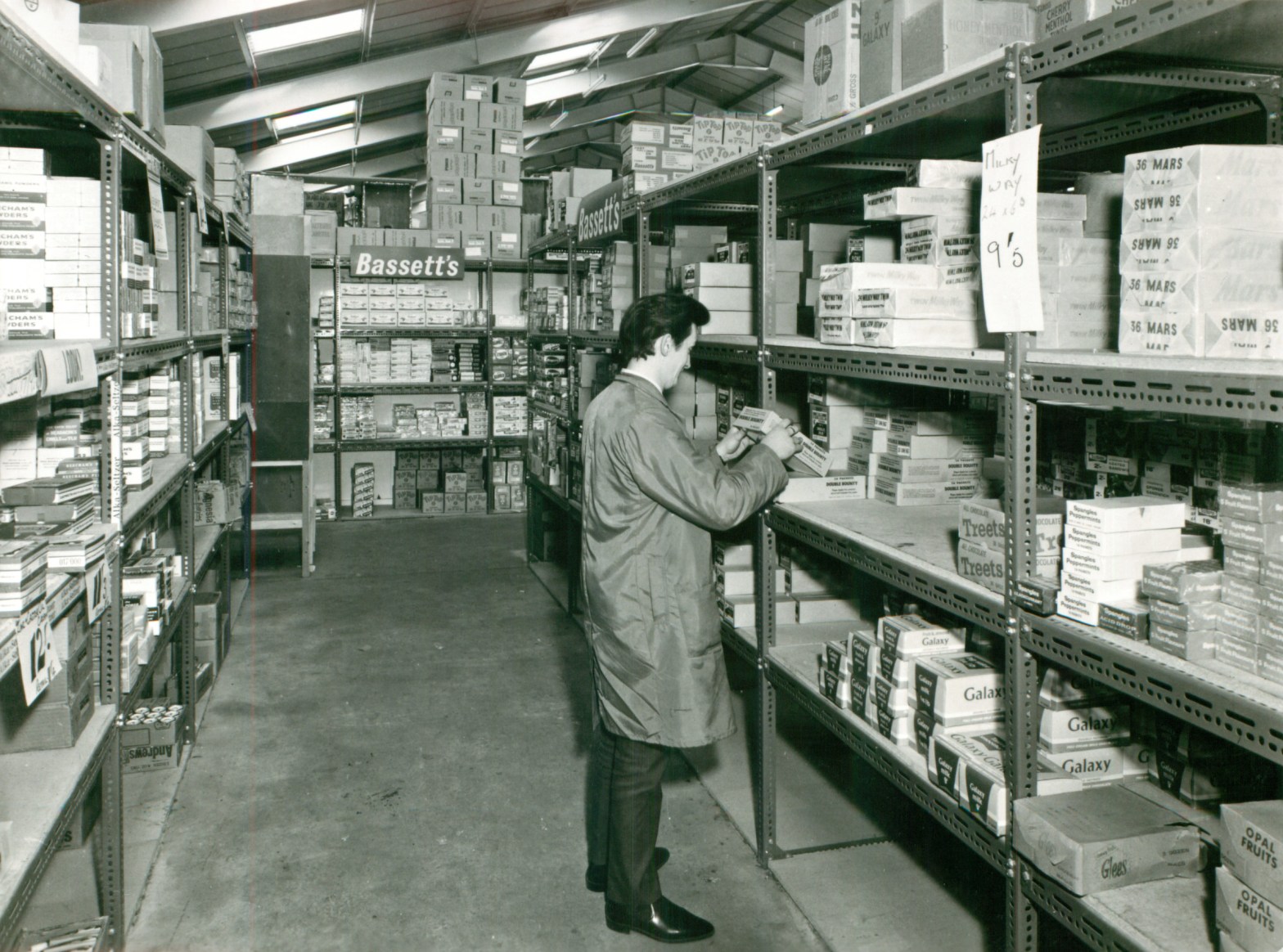
Dexion was a printer’s solution to a printers’ problem. Demetrius Comino, an Australian-Greek immigrant to the UK established a printing business. Curiosity about how better to store things and lay out space led him to develop ‘slotted angle’, long strips of metal, folded to create an L shape down the length, but crucially perforated with a selection of holes, and marked every three inches. Dexion slotted angle was born in 1947, and the Dexion company was established in 1949. The original printing firm, Krisson, continued trading as a partner company to Dexion.
With its scientific design of slots and holes, Dexion is unusually strong, easily joined. Because Dexion can be used over and over again there is no waste.
What Is Dexion? From Dexion Angle Magazine, Issue 4
While the material could reasonably have been envisioned as an industrialisation of earlier uses of wood, metal and bolts; what is remarkable is the amazing number of uses found for this material when combined with bolts and a suitable cutter.
Keeping to printing, I’ve seen small stands for printers’ saws, workbenches but also staircases and offices perched on the top of Dexion angle.

In 1962, as part of their series Production Aids for the Printing Industry, the British federation of Master Printers offered a lovely leaflet, Uses for Slotted Angle, as the more generic name for what was now a widely-imitated idea.
The printer can reap great advantage from its simplicity, universal application and low cost. It can be widely used in composing and machine rooms, bindery, litho and gravure departments, warehouse and also in offices.
British Federation of Master Printers, Uses for Slotted Angle.
The BFMP suggested using slotted angle to create machine guards, special trolleys to correct Monotype material and above larger presses to hold paper for tympans.
Away from printing, Dexion was used for a myriad of things. Following earthquakes in Greece in August 1953, Dexion offered 20,000 feet of the material and sent engineers to build prototype homes.

Eventually, 3,000,000 feet of Dexion was used in the re-construction of 2,000 homes.
Dexion’s own magazines —Dexion Angle for customers and Good Company for staff record some of these creative uses.
One terrifying photo shows Dexy, a 17’6″ robot made from 871 feet of Dexion shown at the Canadian National Materials Handling Exhibition.
Year and Era
1947 / Modern
Object Type
Other Objects
Location
Head Office: Dexion Limited, Maygrove Road, London, NW6
Factories: Waltham Abbey, Enfield, South Chingford, Hemel Hempstead
Sources and More Information
An Appeal
If you have Dexion paperwork, including anything like catalogues, newsletters like Dexion Angle or examples of the amazing uses Dexion was put to, please get in touch.
Header Image: “File:Old-slotted-angle-shelving.jpg” by ConstructorGrp is licensed with CC BY-SA 3.0.
 British Letterpress in 100 Objects